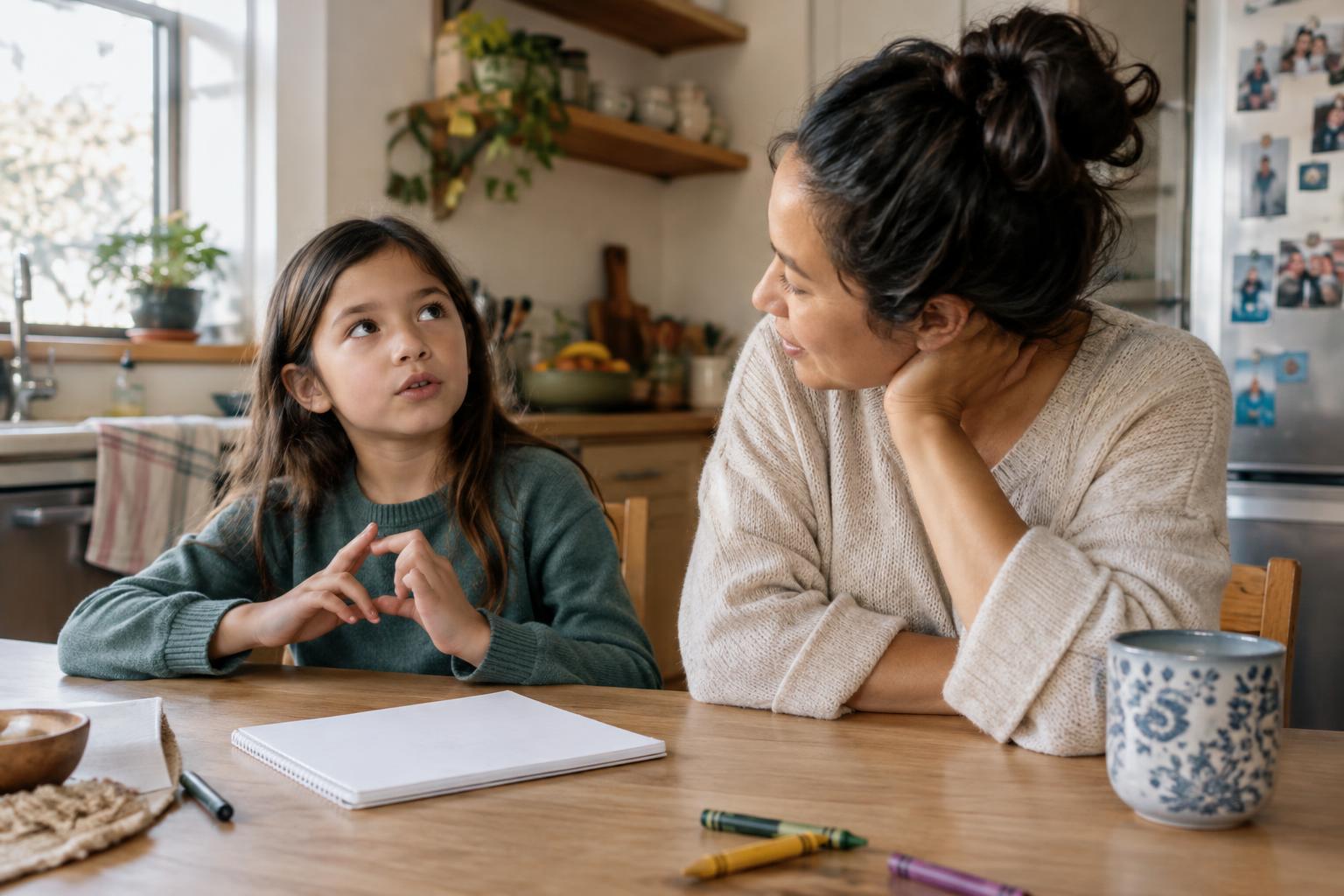
Look for moments already in the day
A busy family day can make a proper conversation feel like one more task to schedule. Yet talking often fits best inside things you are already doing: walking to the bus, putting away groceries or waiting for pasta to cook. These moments are short, but they can be less pressured than sitting down specifically to talk. A child can help sort socks while telling you about a game they invented, or point out something interesting on the way home.
Try noticing when your child is most inclined to chat. Some children talk as soon as they get home; others need time to play, eat or rest first. You do not need to turn every routine into a conversation. Leaving a little space—such as setting your phone aside during a short walk—makes it easier to respond when your child starts one.
Start small and follow their lead
Questions such as “How was your day?” may be hard to answer, especially when a child is tired. A smaller question can be easier: “What did you build today?” or “Who made you laugh?” If they bring up a toy, a friend or a puddle they jumped over, follow that subject for a while. You can ask what happened next, reflect back what you heard or simply enjoy the story.
Age and temperament matter. A young child may communicate through gestures, repeated words or pretend play. An older child may prefer to talk while doing something else, without steady eye contact. Neither style needs to look like a formal exchange to count as connection. If your child gives a one-word answer, you can share a small detail from your own day and leave the conversation open rather than pressing for more.
Make shared tasks easier to talk through
Chores can offer a natural focus for side-by-side conversation. While preparing a snack, you might invite a child to choose between two fruits and ask what they would pack for a picnic. While tidying, you might remember where a particular object came from. The task gives both of you something to do with your hands, which can make pauses feel comfortable rather than awkward.
For younger children, narrating simple actions can be a way to connect: “You found the blue cup. Let’s put it on the table.” School-age children might enjoy helping plan a meal or explaining the rules of a game they like. Older children may appreciate being asked for an opinion about a shared household decision. Keep invitations genuine and manageable; a conversation is more enjoyable when it does not disguise an unwanted chore as a choice.
Listen without rushing to fix everything
When a child mentions a difficult part of their day, it is tempting to jump straight to a solution. Sometimes the first useful response is simply to listen: “That sounds frustrating,” or “Do you want to tell me more?” You can check whether they want help thinking through what to do next or would rather have you hear them out. This leaves room for their point of view, even when you see the situation differently.
Listening also includes knowing when to pause. If you are distracted or running late, it is reasonable to say so kindly: “I want to hear the rest. Can we talk when we get home?” Follow through when you can. A short, attentive exchange is often more satisfying than a longer one in which everyone is trying to do three things at once.
Keep the invitation open
No family can have a meaningful conversation at every meal or bedtime. Some days are noisy, and some children would rather be quiet. A simple ritual can help without becoming a rule: sharing one good thing from the day while clearing plates, choosing a question for a walk or chatting for a few minutes before the lights go out. It is fine to skip it when the day does not allow it.
The aim is not to collect perfect answers or make every moment productive. It is to offer regular chances to speak and be heard. When conversation can begin with an observation, a joke or a small question—and can end without a lesson—children have more ways to join in when they are ready.