Start with what your child recognizes
A memory game can begin with a few family photos, drawings, or familiar household objects. Choosing things your child can name or talk about makes the game feel more like play than a test. A picture of the family pet, a favorite cup, or a leaf from a recent walk can invite stories as well as guesses.
Keep the first round small. Place two or three items where everyone can see them, talk about each one, then cover them with a cloth. Ask, “What do you remember?” There is no need to insist on an exact answer. A child might recall a color, where an object was placed, or something it reminds them of. Those details give you a way to keep the conversation going.
Make a picture-pair game
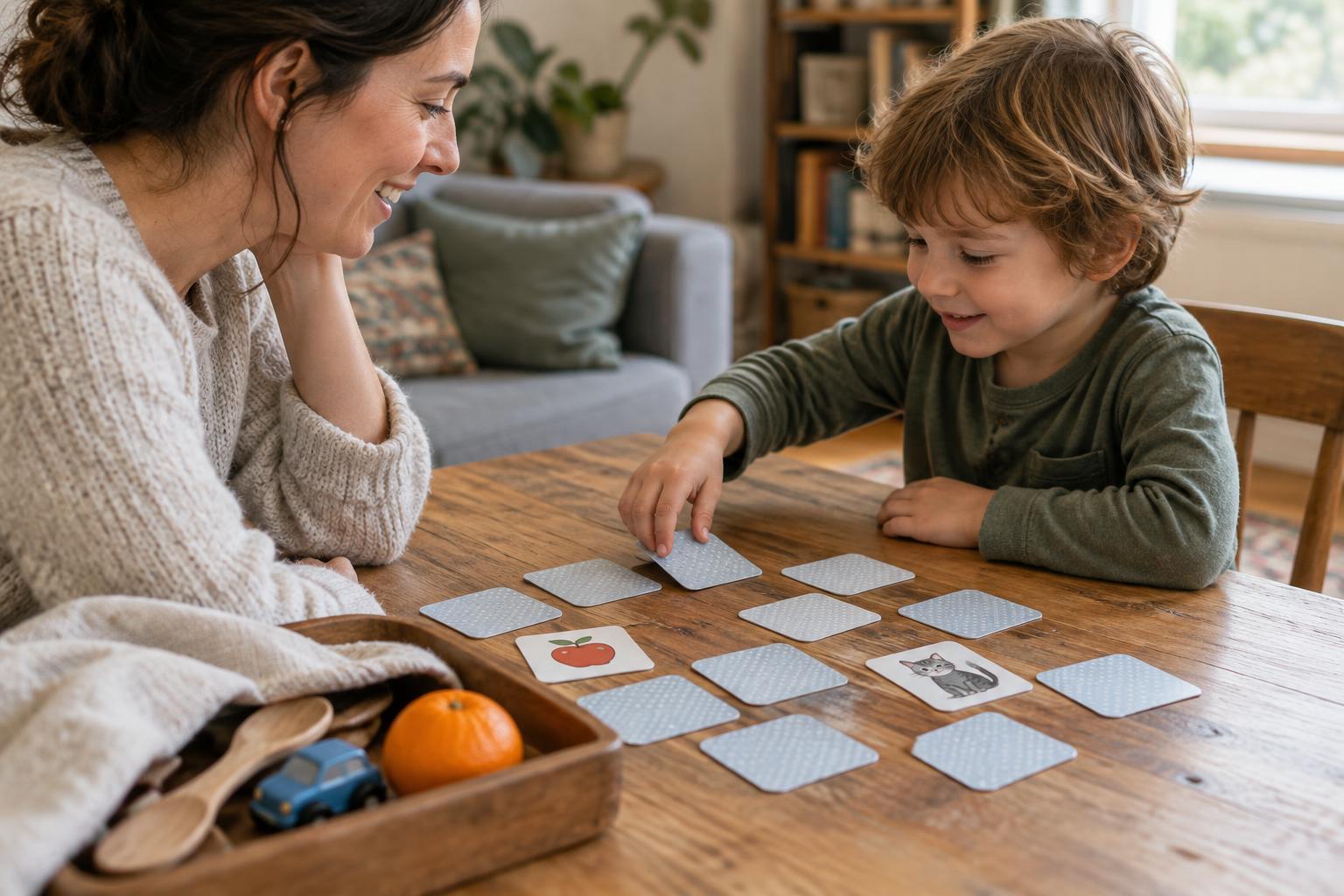
For a simple matching game, draw or print two copies of a few pictures. They might show animals, foods, or objects from your home. Turn the pictures face down and take turns flipping over two at a time. If they match, leave them face up; if not, turn them back over. Players can say what they noticed: “The blue bowl was near the corner.” This gives everyone a chance to share a remembering strategy without making the game too serious.
Begin with just two pairs for a child who is new to the game, then add more if they want a challenge. Older children may enjoy making the cards themselves or choosing a theme, such as things seen on a walk. If you do not have duplicate pictures, use pairs that belong together instead: a sock and a shoe, or a picture of a toothbrush and one of toothpaste. Explain the pairs before turning the cards over so the rules feel clear.
Try the covered-tray challenge
Set out three to five familiar objects on a tray or table. Give everyone a moment to look, then cover the objects. Ask players to name what they saw, point to where an item was, or describe one detail. Another version is to uncover the tray after quietly removing one object and ask, “What is missing?” Let children help choose the objects for the next round; selecting them can be as enjoyable as remembering them.
You can change just one feature at a time. Move an object to a new spot, swap one item for another, or add something new. For younger children, use larger, distinct objects and leave plenty of time to look. For children who want more difficulty, choose items with a shared feature, such as several different spoons. Use objects that are safe for the children playing, and keep small pieces out of reach of children who may put them in their mouths.
Turn everyday moments into recall games
Pictures and objects can also help children remember a short sequence. Put out three photos from a familiar activity, such as getting ready to go outside: shoes, coat, and door. Mix them up and invite your child to arrange them in the order they usually happen. Ask, “What might come next?” Their version may differ from yours, which can lead to a useful conversation about the routine.
On a walk, each person can choose one thing to remember: a tree shape, a colorful gate, or a sound. When you get home, draw the things you noticed and see what everyone recalls. There is no need to check every answer. The point is to pay attention together and enjoy hearing what stood out to each person. If drawing feels like too much, simply talk about the walk while putting shoes away.
Keep the game inviting
Short rounds often work better than a long session, especially when a child is tired or ready to move. Offer a choice between looking at pictures and handling objects, and let children stop or change the rules. You can play cooperatively by trying to remember as a team rather than keeping score. Taking turns being the person who sets up the tray also gives a child a different role in the game.
When an answer is missed, reveal the item with curiosity: “Oh, it was the red cup! I forgot that one too.” Notice the approaches children try, such as naming objects aloud or grouping similar pictures. Familiar materials can be used again in new combinations, so a few minutes of play can fit naturally into an ordinary day.