Start with the space you have
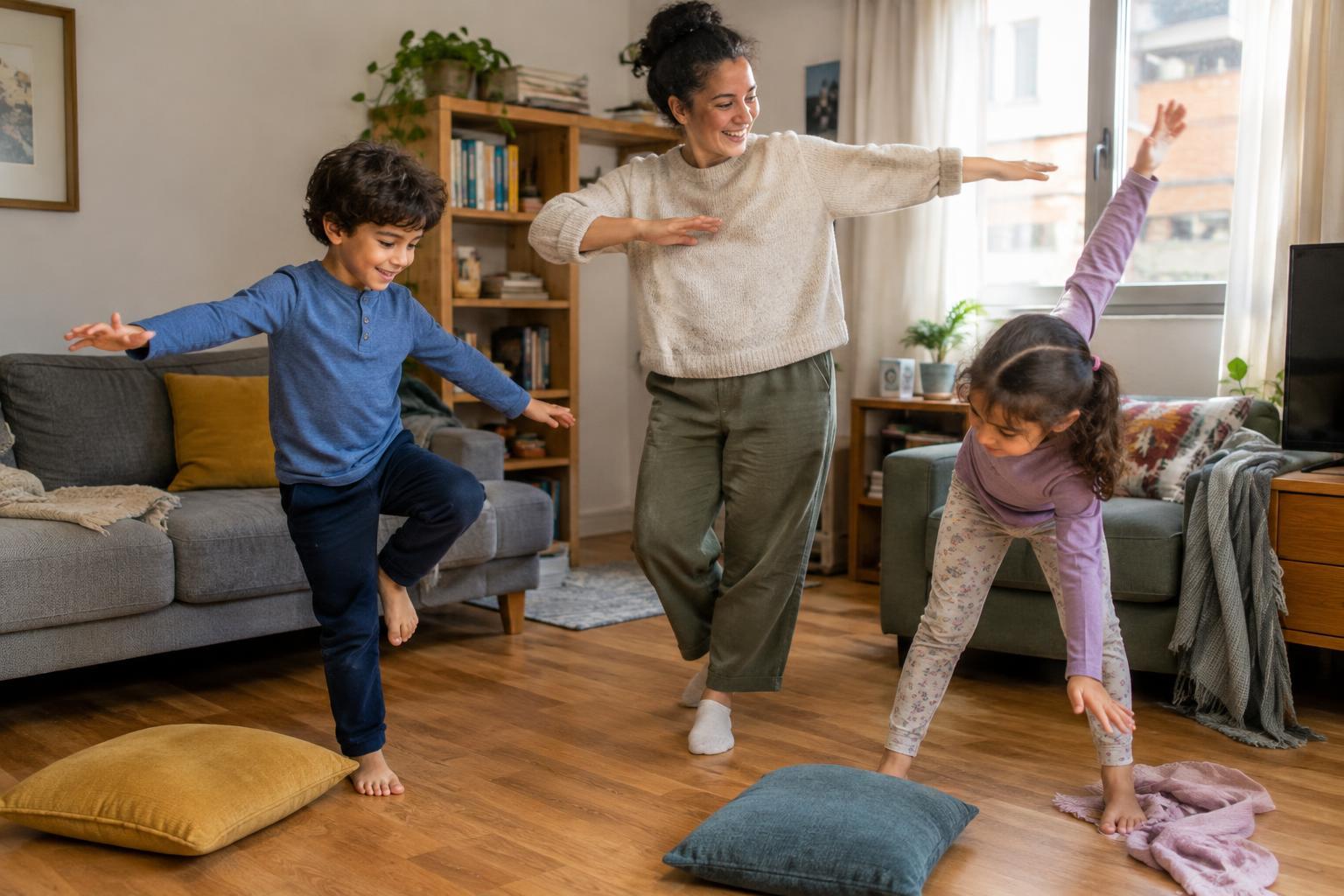
Indoor movement does not need a large room or elaborate equipment. A clear patch of floor can become a path, a pretend island or a place to copy funny poses. On days when going outside is difficult, a short game can offer a change of pace without turning the living room into an obstacle course.
Before starting, move breakable objects aside and check that the floor is not slippery. Keep games away from stairs, sharp furniture corners and anything that could tip over. Choose movements that fit the room: stepping, reaching, balancing and gentle crawling often work better than running or jumping. If children of different ages are playing together, give each person a version that feels comfortable rather than expecting everyone to move in the same way.
Make a path without building a course
For a follow-the-path game, place a few pieces of paper on the floor with enough space between them for easy steps. Invite your child to travel from one to the next: take giant steps, tiptoe, walk sideways or pause for a pose at each stop. You can change the story without changing the setup. The papers might be stepping-stones across a river, stations on a train route or places to deliver imaginary parcels.
Younger children may enjoy simply reaching each marker with you nearby. Older children can help plan the route or invent a new way to travel between stops. Keep the path short if the room is tight, and let players take turns so they do not have to dodge one another. If loose paper slides on your floor, skip the markers and point out imaginary stops instead.
Play games that move in place
A mirror game uses no equipment at all. Stand or sit facing your child and make slow movements for them to copy: stretch your arms wide, turn your hands like wheels or lean gently from side to side. Then swap roles. Copying is part of the fun, but there is no need to get every movement right. A child who invents an unexpected move is giving you a new idea to try.
For a stop-and-start game, agree on a movement such as marching on the spot or swaying like a tree. Say “go” to begin and “pause” to become still. Let children call the cues when they are ready. You can add pretend-play prompts—move like a sleepy cat, a tall robot or a tiny seed growing into a plant. Use a speaking voice rather than loud music if noise is a concern, and keep the pace gentle enough for the available space.
Give familiar objects a playful job
A soft cushion can be a pretend mountain to walk around, while a scarf can become a ribbon to wave through the air. With a pair of rolled-up socks, try tossing into an empty laundry basket from a comfortable distance. Players can move the basket closer or farther away, switch hands or invent their own ways to score. The aim is to explore movement, not to win.
Choose objects with the children and check that they suit the players. Small items may not be appropriate for children who still put objects in their mouths, and tossed objects should be soft. For a quieter option, carry a soft toy from one side of the room to the other while moving like different animals. A child can choose whether to walk, crawl or simply act out the animal with their arms.
Keep the game flexible
A few minutes of play may be enough, especially when attention is shifting or the room feels crowded. Offer a choice between two games, then let children help decide when to change or stop. Some may want to repeat the same path many times; others may prefer to watch before joining. Watching, suggesting a character or calling out cues can all be ways to take part.
You can end with a calm transition: put the markers away together, stretch gently or sit down to talk about the funniest move. The most useful indoor games are often the ones you can adjust on the spot. When the rules fit the people and the space, even a small room can hold plenty of play.