Start with a small, safe collection
A few familiar objects are enough to begin. Gather items such as clean socks, washcloths, plastic cups, wooden spoons, or large blocks. Choose objects that can be handled comfortably and place them on a clear patch of floor or table. Keeping the collection small makes it easier for a child to notice differences without feeling that there is one big task to finish.
Match the materials to the child. For younger children who still put things in their mouths, avoid small pieces and anything that could break, pinch, or pose a choking risk. Check that containers have no sharp edges, and supervise play with household objects. Older children may enjoy a wider mix of colors, shapes, and textures, provided the items are safe for them to use.
Sort in more than one way
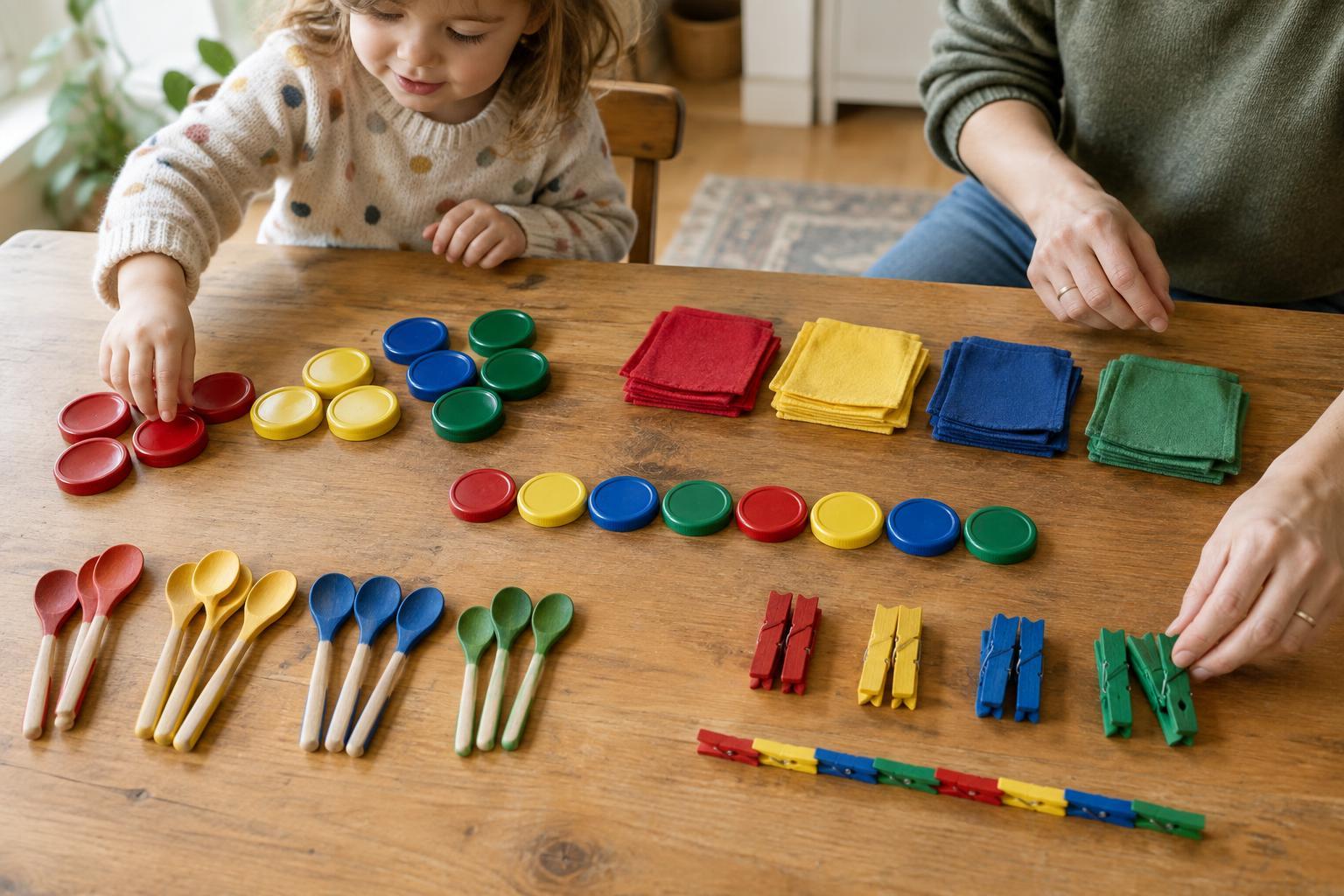
Begin by placing two groups side by side. You might put long socks in one pile and short socks in another, or sort cups by color. Rather than giving detailed directions, try a simple invitation: “Which ones belong together?” A child may choose a feature you did not expect, such as placing all the soft things together. Ask what they noticed before suggesting another way to sort.
The same collection can support several rounds of play. Sort washcloths by color, then unfold them and sort by size. Group spoons and cups by what they are, then try grouping items by material. For a younger child, moving objects into and out of two containers may be the most interesting part. An older child might enjoy making a group with a rule for you to guess.
Turn matching into a search
Matching gives children a reason to look closely. Lay out a few socks and invite your child to find pairs. Or place two sets of safe, familiar objects in separate baskets and take turns finding ones that match. At first, obvious pairs are easiest to spot. Later, similar-looking items can make the search more interesting: two blue socks might differ in length or pattern.
A match does not always have to mean “exactly the same.” A child might pair a spoon with a bowl because they use them together, or place two differently colored cups side by side because they share a shape. If the connection is not clear, ask, “How do these go together?” Listening to the answer keeps the activity open-ended and gives your child room to describe their thinking.
Build patterns you can see and hear
Once sorting and matching feel familiar, arrange objects in a repeating line. Try cup, spoon, cup, spoon, then pause and ask what could come next. Keep the first pattern short and easy to see. Your child can add an item, copy the line, or take it apart and start a new one. Patterns can also be made with actions: clap, tap the table, clap, tap the table.
If your child wants a challenge, try two of one item followed by one of another, or build a pattern with three different objects. You can deliberately leave a gap in the middle and invite them to fill it. It is fine if they make something different instead. Ask them to show you how their arrangement works; they may be making a pattern of their own.
Keep the play flexible
Short turns often work better than a long planned lesson. A sorting game can happen while folding laundry, putting away unbreakable dishes, or tidying toys. You can name what you see without correcting every choice: “You put all the striped ones here.” When a child changes the rule halfway through, the new rule can become the game.
Follow their interest and stop when attention moves elsewhere. Some children enjoy carefully lining objects up; others prefer to carry, stack, or rearrange them. Those moments can still lead to noticing similarities and differences. Put the objects away together when you are done, and leave the idea ready to revisit with a new collection another day.